
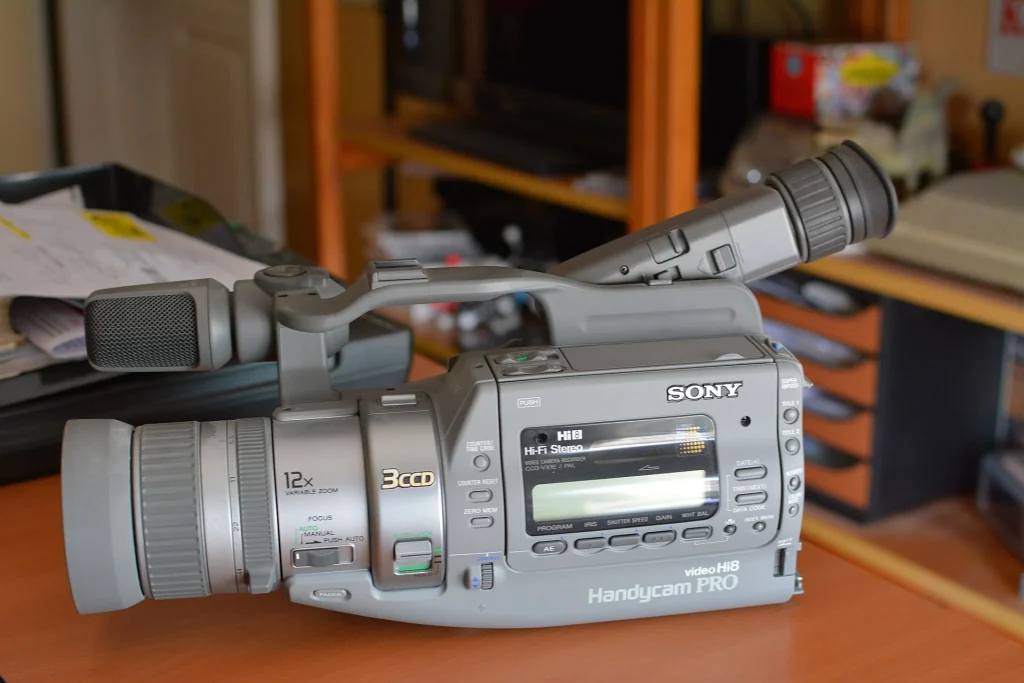
Through the late 1980s and the 1990s, the small 8mm video cassette was the most popular way to shoot home movies. Those tapes can only be played on an 8mm camcorder or deck, and none have been made for years. A working Hi8 camcorder is both the way to rescue old footage and a fun camera in its own right.
What to Look For
- Plays a tape with a clean, steady picture and clear sound
- Loads and ejects tapes smoothly, with no error codes
- Records and plays back its own footage
- Power adapter or charger is included, along with the video output cable
- Viewfinder or flip-out screen works, and the zoom and autofocus respond
Popular Models Worth Seeking Out
Sony created the format and made most of the best machines.
- Sony CCD-TRV series (CCD-TRV65, CCD-TRV68 and similar) — late Hi8 Handycams with flip-out screens. Common and dependable.
- Sony Digital8 camcorders (DCR-TRV series) — many models also play analog Hi8 and Video8 tapes and output them digitally, which makes transfers simple. Check the exact model first.
- Sony CCD-TR series — compact viewfinder-only Handycams from the early 1990s. Charming, but often in need of repair.
- Sony CCD-VX1 and CCD-VX3 — three-chip models aimed at serious users, with noticeably better color.
- Canon ES and UC series — solid alternatives with good lenses.
Our Pick: A Tested Sony Hi8 Handycam with Charger and Cables
A late-1990s Sony Hi8 model is the practical buy. It plays both Hi8 and older Video8 tapes, parts and batteries are still easy to find, and later machines avoid the capacitor problems of earlier ones.
THE VERDICT
- Playback: Clean picture and sound
- Tape Transport: Tested, no errors
- Outputs: Video cable included
- Power: Adapter or charger included
Best for: families with 8mm video tapes to rescue, and creators chasing the 1990s home-video look.
Pros & Cons
Pros
- Hi8 machines also play standard Video8 tapes
- Compact and inexpensive
- Connects to a capture device for digitizing
Cons
- No new machines are made, and original batteries are usually dead
- Early 1990s models are prone to leaking capacitors
Common Problems to Watch For
- Leaking capacitors — common in early 1990s camcorders, causing no picture, no sound or a dead viewfinder.
- Dirty or worn heads — a noisy, streaky picture. Cleaning helps; wear does not improve.
- Loading and eject faults — the tape door will not open or the camcorder shows an error code. Usually a worn mechanism.
- Dead batteries — original packs no longer hold a charge. Use the mains adapter or buy a new pack.
- Sticky rubber — grips and eyecups break down and turn tacky.
How Much Should You Expect to Pay
- $30–$60: Untested camcorders, sold as-is
- $60–$150: Tested Video8 and Hi8 camcorders
- $150–$300: Digital8 models that play analog tapes
- $300+: Three-chip models and serviced machines sold for transfers
Keeping an 8mm Camcorder Working
- Store it with no tape inside and the battery removed
- Run it for a few minutes every couple of months to keep the mechanism free
- Keep tapes cool, dry and upright in their cases
Quick Questions, Answered
What is the difference between Hi8 and Video8?
They use the same size cassette. Hi8 records a sharper picture, and Hi8 machines play Video8 tapes, but not the other way round.
How do I digitize my tapes?
Connect the camcorder’s video output to a USB capture device, or use a compatible Digital8 camcorder and transfer over FireWire.
Can I still buy blank tapes?
Yes. Sealed new-old-stock Hi8 tapes are still widely sold.
Never test an unknown camcorder with your only copy of an important tape. Use a tape you do not mind losing first, and check that it loads, plays and ejects cleanly.