
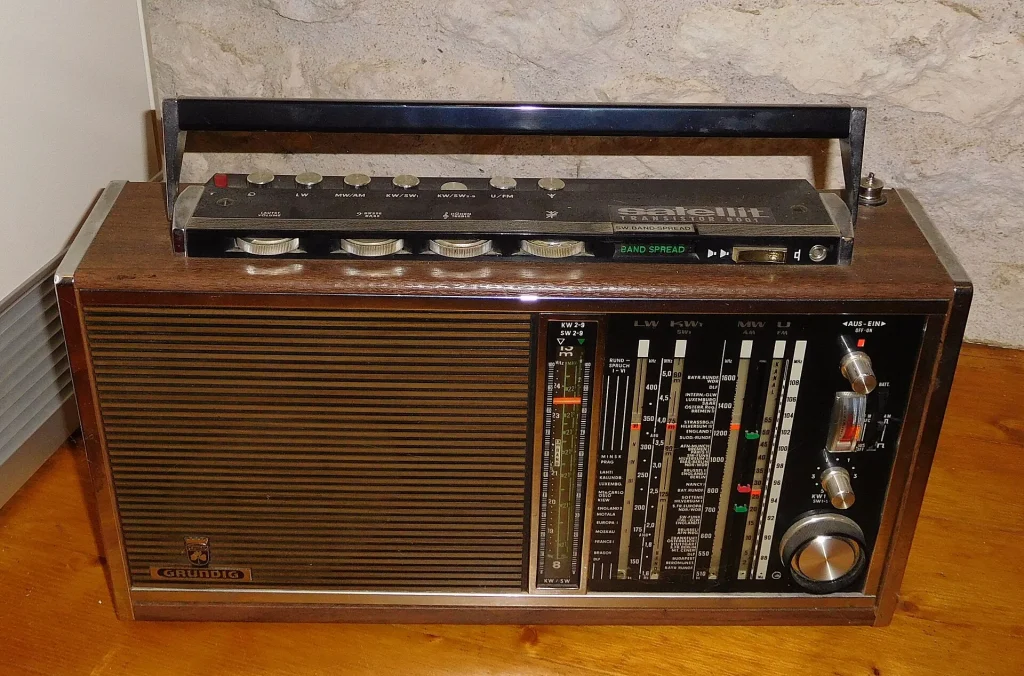
Shortwave radio lets you hear broadcasts from other continents with nothing more than a receiver and a length of wire. There are fewer big international stations than there once were, but plenty remain, along with amateur operators, time signals and utility stations. A good vintage receiver makes tuning them a pleasure, and no license is needed to listen.
What to Look For
- Receives on all bands, with stations audible on several shortwave ranges after dark
- Tuning is smooth, and the dial or digital display tracks accurately
- Controls and band switches are free of crackle and dropouts
- Battery compartment is clean and the telescopic antenna is complete
- SSB or BFO capability, if you want to hear amateur radio operators
Popular Models Worth Seeking Out
These receivers earned their reputations with listeners over decades.
- Sony ICF-2010 (ICF-2001D outside North America) — often called the best portable shortwave radio ever made, with synchronous detection.
- Grundig Satellit series (Satellit 210, 2100, 650) — large German portables with rich sound and strong performance.
- Zenith Trans-Oceanic (Royal 1000, Royal 3000) — handsome American classics, as much furniture as radio.
- Panasonic RF-2200 — a superb analog portable, especially strong on medium wave.
- Realistic DX-160 and Yaesu FRG-7 — affordable tabletop receivers that reward patient tuning.
Our Pick: A Working Multi-Band Portable from the 1970s or 80s
A portable is the easiest way to begin. It runs on batteries, has its own antenna, and you can carry it outside or to a window, away from the electrical noise that spoils reception indoors.
THE VERDICT
- Bands: All receiving
- Tuning: Smooth and accurate
- Controls: Clean, no crackle
- Antenna: Complete
Best for: curious listeners who want to tune the world by hand without needing a license or a big antenna.
Pros & Cons
Pros
- No license, subscription or internet connection required
- Portables work anywhere on batteries
- Well-made sets with good speakers and audio
Cons
- Fewer international broadcasters on the air than in past decades
- Modern household electronics create interference that limits indoor reception
Common Problems to Watch For
- Dirty band switches — a band that cuts out or crackles. Contact cleaner usually restores it.
- Broken dial cord — the tuning knob turns but the pointer does not move.
- Battery corrosion — very common in portables stored with cells inside.
- Aged capacitors — weak, distorted or humming audio in sets that have never been serviced.
- Static damage — the Sony ICF-2010 has a known weak point at its antenna input, so ask whether it receives well on the whip antenna.
How Much Should You Expect to Pay
- $40–$90: Basic multi-band portables in working order
- $90–$200: Grundig Satellit and Zenith Trans-Oceanic transistor models
- $200–$400: Sony ICF-2010 and Panasonic RF-2200 in good condition
- $400+: Serviced top-tier portables and premium tabletop receivers
Quick Questions, Answered
Do I need a license to listen?
No. Listening is unrestricted in the United States and most other countries. A license is only needed to transmit.
What can I actually hear today?
International broadcasters, religious and private stations, amateur radio operators, time signals and aviation weather, depending on the time of day.
Do I need an outdoor antenna?
Not to start. The built-in whip works, and ten or twenty feet of wire clipped to it and run to a window improves reception a great deal.
Listen after sunset. Shortwave signals travel much farther at night on the lower bands, and a radio that seems dead at midday can be full of stations by evening.