
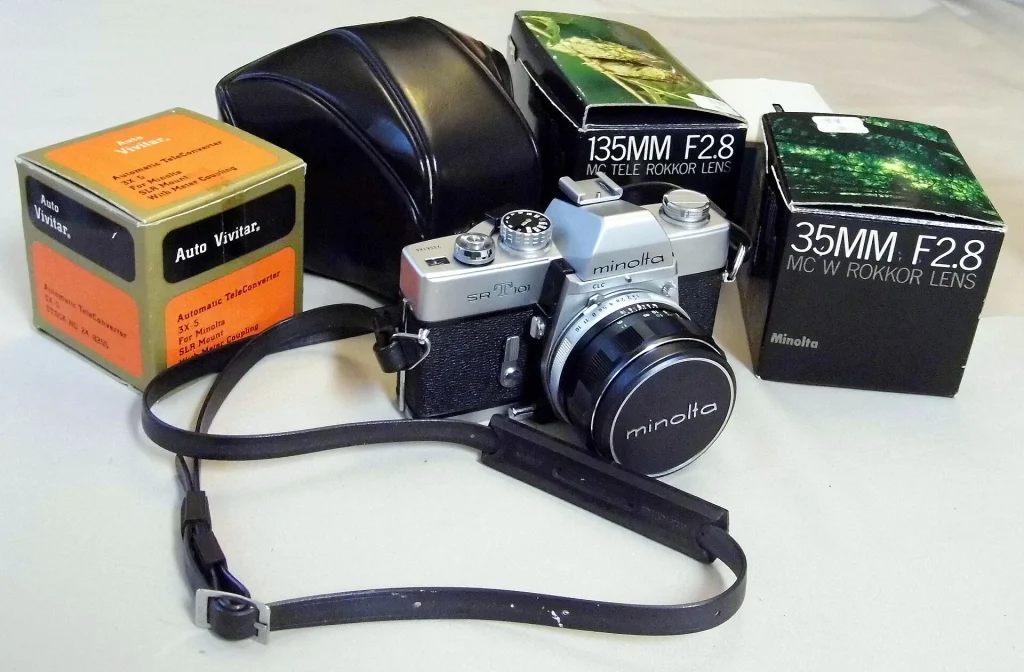
Old manual-focus lenses are one of the best bargains in photography. A fast 50mm that cost a week’s wages in 1978 can now be had for the price of a dinner, and it will work on its original film body or, with an adapter, on a modern mirrorless camera. Glass ages, though, so condition matters more than the name on the barrel.
What to Look For
- Glass is clear when you shine a light through it: no fungus threads, haze or separation
- Aperture blades are dry and snap open and closed instantly
- Focus ring turns smoothly through its whole range, without stiff spots or play
- Mount matches your camera body or a readily available adapter
- Front and rear elements are free of deep scratches, especially the rear
Popular Models Worth Seeking Out
These lenses were made in huge numbers, perform well and are easy to find in clean condition.
- Canon FD 50mm f/1.8 — sharp, light and cheap. The natural partner for an AE-1 or A-1.
- Pentax SMC Takumar and SMC Pentax-M 50mm f/1.7 — beautifully built, with coatings that still hold up well.
- Minolta MC and MD Rokkor 50mm f/1.7 and 58mm f/1.4 — smooth rendering and excellent value.
- Nikon Nikkor AI 50mm f/1.8 and 105mm f/2.5 — the 105mm is one of the great portrait lenses of the film era.
- Helios 44-2 58mm f/2 — a Soviet lens in M42 mount, loved for its swirling background blur.
Our Pick: A Clean 50mm f/1.8 in Your Camera’s Mount
Start with the standard lens. A 50mm at f/1.8 or f/1.7 is sharp, bright enough for indoor light and usually the cheapest lens in any system, so you can afford to be fussy about condition.
THE VERDICT
- Glass: Clear, no fungus or haze
- Aperture: Snappy, no oil
- Focus: Smooth
- Mount: Matches your body
Best for: film shooters adding a second lens, and digital shooters who want character on a budget with an adapter.
Pros & Cons
Pros
- Excellent image quality for very little money
- All-metal construction that can be cleaned and serviced
- Usable on mirrorless digital cameras with a simple adapter
Cons
- Manual focus only, and no stabilization
- Fungus and haze are common and not always shown in photos
Common Problems to Watch For
- Fungus — fine web-like threads inside the glass. Light cases can be cleaned, but it may have etched the coating.
- Haze — a milky film on inner elements from evaporated lubricant. It lowers contrast, especially when shooting toward the light.
- Oily aperture blades — blades stick or close slowly, which causes overexposure on SLR bodies.
- Stiff or dried focusing grease — the ring is hard to turn or feels gritty. A service fixes it.
- Yellowed glass — some early Takumars with thorium elements turn amber. Exposure to UV light clears it.
How Much Should You Expect to Pay
- $20–$50: Common 50mm f/1.8 and f/2 lenses
- $50–$120: Clean 28mm and 135mm primes, and 50mm f/1.4 lenses
- $120–$300: Fast wide-angles, 85mm portrait lenses and sought-after Nikkors
- $300+: Rare, very fast or cult-status glass
Looking After Old Lenses
- Store lenses in a dry, airy place and not in a sealed leather case, which traps moisture
- Use them regularly, because light and movement discourage fungus
- Keep front and rear caps on, and add a lens hood to protect the front element
Quick Questions, Answered
Will a vintage lens fit my digital camera?
On most mirrorless cameras, yes, with an inexpensive mount adapter. You focus and set the aperture by hand.
Is a little dust inside a problem?
No. A few specks of dust inside an old lens have no visible effect on pictures.
Should I get f/1.4 or f/1.8?
The f/1.8 is usually the better buy. The f/1.4 costs more and gains less than one stop of light.
Ask the seller to shine a phone flashlight through the lens from behind and photograph it. That one picture reveals fungus, haze and scratches that a normal product photo hides.