
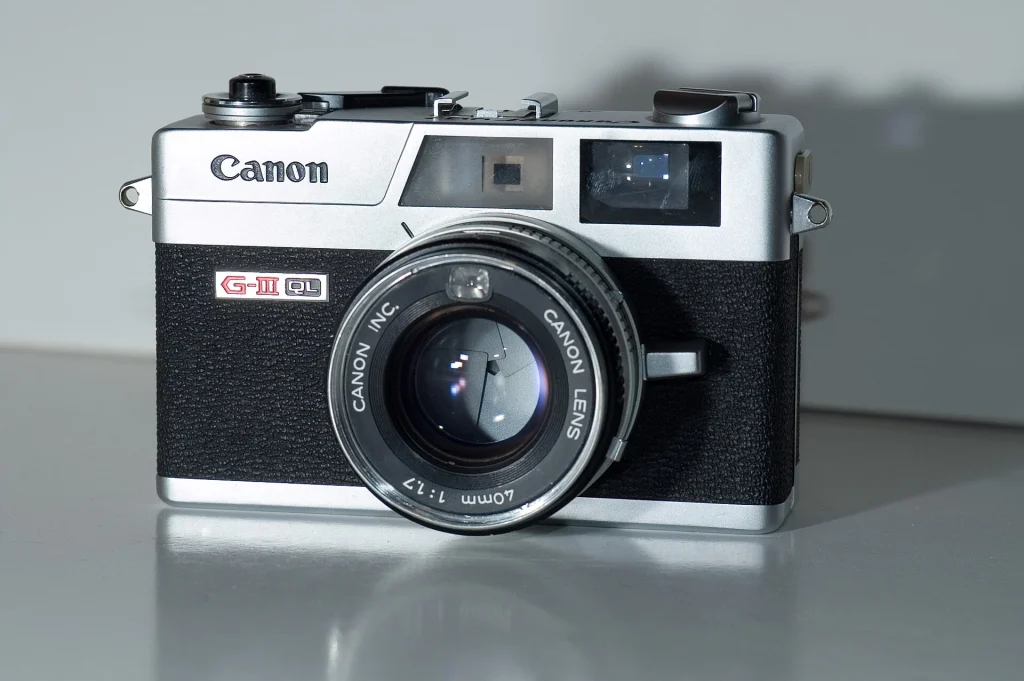
Fixed-lens rangefinders from the 1960s and 70s pack a fast, sharp lens into a body that fits in a coat pocket. They are quieter than an SLR, simpler to carry and much cheaper than a Leica. Fifty years on, shutters stick and light seals crumble, so a tested camera is worth the premium.
What to Look For
- Rangefinder patch is bright, and the two images line up at infinity
- Shutter fires at every speed, and the blades are clean and dry
- Light meter responds, and the battery compartment is free of corrosion
- Lens is clear, with no haze, fungus or heavy scratches
- Light seals have been replaced, or you have budgeted for a seal kit
Popular Models Worth Seeking Out
These are the cameras that built the reputation of the fixed-lens rangefinder.
- Canon Canonet QL17 G-III — a superb 40mm f/1.7 lens, shutter-priority automation and full manual control. The most popular choice.
- Yashica Electro 35 (GSN, GTN) — aperture-priority automation and an excellent 45mm f/1.7 lens for little money.
- Olympus 35 RC and 35 SP — the RC is tiny and fully usable without a battery; the SP has a superb lens and a spot meter.
- Minolta Hi-Matic 7s and 7sII — sharp Rokkor lenses and solid build, often overlooked.
- Konica Auto S2 — an underrated camera with an outstanding Hexanon lens.
Our Pick: A Serviced Canon Canonet QL17 G-III
The Canonet earns its reputation. It is compact, the lens is excellent, the quick-loading system makes film changes easy, and it works in full manual if the meter ever fails.
THE VERDICT
- Rangefinder: Bright and aligned
- Shutter: All speeds firing
- Meter: Working
- Light Seals: Replaced
Best for: street and travel photographers who want SLR-quality pictures from a smaller, quieter camera.
Pros & Cons
Pros
- Fast, sharp lens in a compact body
- Near-silent leaf shutter that syncs with flash at every speed
- Far cheaper than interchangeable-lens rangefinders
Cons
- The lens is fixed, so one focal length is all you get
- Many were designed for mercury batteries that are no longer made
Common Problems to Watch For
- Sticky shutter or aperture blades — old oil migrates onto the blades and slows them. A service clears it.
- Dim or misaligned rangefinder — makes accurate focusing difficult. It can be cleaned and adjusted.
- Perished light seals — the foam turns to tar and leaks light onto the film. Kits are cheap.
- Yashica Electro pad failure — a small internal rubber pad decays and the automatic exposure stops working. A known and repairable fault.
- Dead meter — caused by battery corrosion or a failed cell.
How Much Should You Expect to Pay
- $40–$80: Untested cameras, sold as-is
- $80–$150: Working Yashica, Minolta and Konica models
- $150–$300: Tested Canonet G-III and Olympus 35 RC
- $300+: Serviced Olympus 35 SP and black-finish cameras
Quick Questions, Answered
What battery does it take?
Many used 1.35-volt mercury cells. Zinc-air replacements or a simple adapter with a modern cell solve the problem.
How is a rangefinder different from an SLR?
You look through a separate window, not through the lens, and focus by lining up a double image in the center of the viewfinder.
Can I use one without a battery?
The Canonet and Olympus 35 RC work in manual mode without one. The Yashica Electro depends on its battery.
Ask the seller to photograph the viewfinder aimed at a distant object with the lens set to infinity. If the two images sit exactly on top of each other, the rangefinder is in adjustment.