
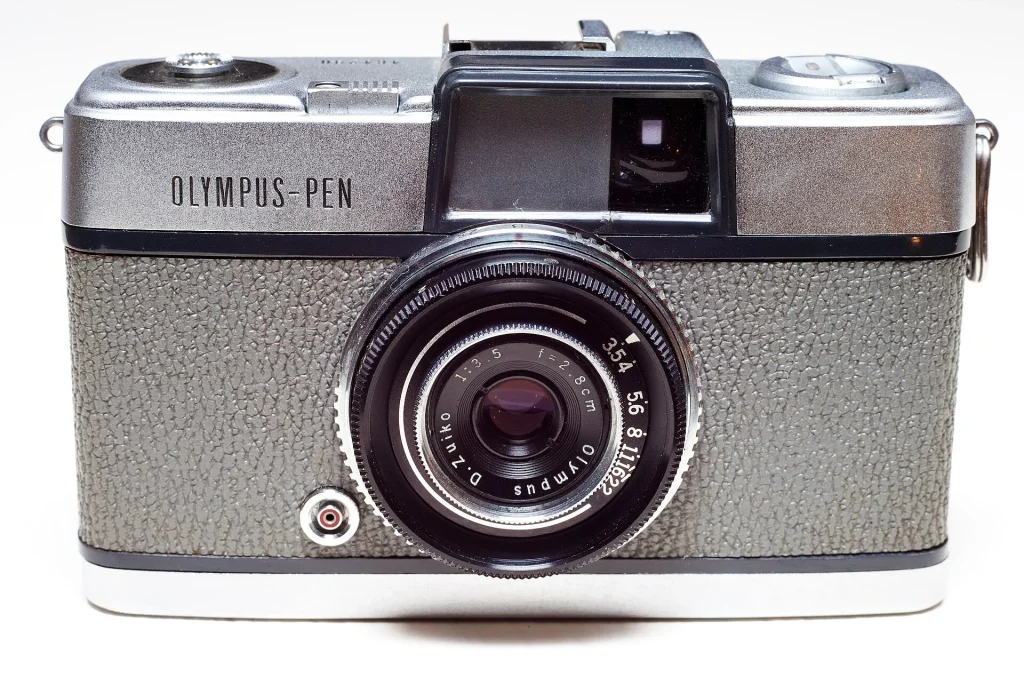
A half-frame camera exposes a frame half the usual size, so a 36-exposure roll gives you 72 pictures. With film prices where they are, that has made these small cameras popular again. The best were built in the 1960s, they are simple to use, and many need no battery at all.
What to Look For
- Meter cell around the lens still responds to light on automatic models
- Shutter fires and the aperture blades open and close freely
- Viewfinder is clear, and the lens is free of haze and fungus
- Film advance, rewind and frame counter all work
- Light seals have been replaced, or you have budgeted for a kit
Popular Models Worth Seeking Out
Olympus dominated half-frame, with a few capable rivals.
- Olympus Pen EE series (EE-2, EE-3, EES-2) — fully automatic point-and-shoot cameras powered by a selenium cell, with no battery needed.
- Olympus Pen D series (D, D2, D3) — a fast lens and full manual control in a pocket-sized body.
- Olympus Pen F and FT — a half-frame SLR system with interchangeable lenses. Beautifully made.
- Canon Demi — well built, with a bright viewfinder and a good lens.
- Ricoh Auto Half — pocketable, with a spring-wound motor that advances the film for you.
Our Pick: A Tested Olympus Pen EE-3
The Pen EE-3 is the easy choice. There is nothing to set beyond the film speed, it needs no battery, and it was made in such numbers that clean, working cameras are easy to find.
THE VERDICT
- Meter: Selenium cell responding
- Shutter: Firing
- Lens: Clear
- Seals: Replaced
Best for: beginners and travelers who want to stretch one roll of film to 72 pictures.
Pros & Cons
Pros
- 72 exposures per roll halves the cost of each picture
- No battery needed on the selenium-cell models
- Small, light and very simple to use
Cons
- The smaller negative shows more grain in big enlargements
- A roll takes a long time to finish, and frames are upright by default
Common Problems to Watch For
- Dead selenium cell — the meter no longer responds, so automatic exposure fails. Cameras stored in the dark with a lens cap fare best.
- Sticky aperture blades — a well-known Pen EE fault that causes overexposure. A cleaning fixes it.
- Hazy viewfinder — makes framing harder but can be cleaned.
- Perished light seals — cause light leaks along the edge of the film.
- Slow shutter or mirror on the Pen F — these SLRs need a proper service after decades unused.
How Much Should You Expect to Pay
- $40–$80: Untested Pen EE models
- $80–$160: Tested Pen EE-2 and EE-3, and Ricoh Auto Half
- $150–$300: Olympus Pen D3 and Canon Demi in good order
- $250+: Olympus Pen F and FT with a lens
Quick Questions, Answered
Can any lab develop half-frame film?
Yes. It is ordinary 35mm film and is processed the same way. Ask the lab how it scans half-frame, since some scan two frames together.
How do I check the meter on a Pen EE?
Point it at something dark and press the shutter: a red flag should appear in the viewfinder and block the shot. In bright light it should fire.
Is the picture quality good enough?
Yes, for small prints and sharing online. Expect more visible grain than full-frame 35mm.
Use the red flag test before you buy, or ask the seller to do it on video. It takes five seconds and tells you whether the selenium meter, the weak point of every Pen EE, is still alive.