
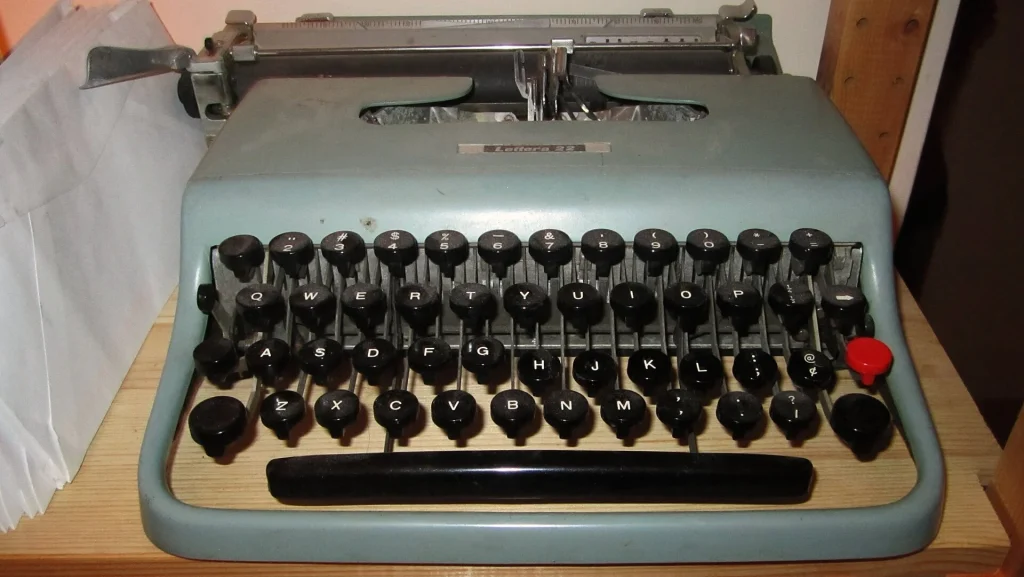
A portable typewriter gives you the full mechanical writing experience in a machine that fits in a case and can be carried in one hand. The best ones were made from the 1950s to the 1970s and are still perfectly usable. The trick is finding one that types cleanly, not one that only looks good in photos.
What to Look For
- Every key strikes and returns freely, with no typebars sticking at the printing point
- Carriage moves smoothly, the bell rings and the carriage return advances the line
- Platen and feed rollers still grip paper and are not rock hard or cracked
- Case is included, with a working latch and handle
- Ribbon spools are present, since some models use their own spool design
Popular Models Worth Seeking Out
These four families cover most of the best portables ever made, and all take ribbon that is still sold.
- Olivetti Lettera 22 and 32 — slim, light and beautifully designed. The classic travel typewriter.
- Hermes 3000 and Hermes Baby — Swiss-made machines with a famously smooth, precise feel.
- Smith-Corona Silent-Super and Sterling — sturdy American portables with a snappy action, plentiful and good value.
- Olympia SM series (SM3, SM4, SM9) — heavier than the others, but often rated the best typing feel of any portable.
Our Pick: A Serviced Mid-Century Portable with Its Case
Choose a machine that has been cleaned and tested over one that is merely pretty. A serviced Smith-Corona or Olympia from the 1950s or 60s types beautifully, costs less than the fashionable Olivetti and Hermes models, and will run for decades.
THE VERDICT
- Keys: All striking cleanly
- Carriage: Smooth, bell working
- Platen: Grips paper
- Case: Included
Best for: writers who want a typewriter they can keep in a closet and carry to the kitchen table.
Pros & Cons
Pros
- Light enough to move and store easily
- No electricity needed
- Standard ribbons are cheap and still manufactured
Cons
- Lighter machines can feel less solid than a full-size desktop model
- Shipping damage is common when a machine is sent without the carriage locked
Common Problems to Watch For
- Sticky typebars — old oil and dust gum up the segment, so keys return slowly. Cleaning with a solvent usually cures it.
- Hardened platen — the rubber roller turns glassy, so paper slips and typing is loud. A specialist can re-cover it.
- Carriage lock mistaken for a fault — many portables have a travel lock that stops the carriage moving. Check for it before assuming the machine is broken.
- Broken drawband — the cord that pulls the carriage has snapped, so the carriage does not advance.
- Dried ribbon — faint typing is normally just the ribbon. Replace it first.
How Much Should You Expect to Pay
- $40–$90: Untested machines, sold as-is
- $90–$200: Working Smith-Corona, Royal and Remington portables
- $200–$400: Serviced Olympia SM and Olivetti Lettera models
- $400+: Hermes 3000 in top condition, and rare colors or typefaces
Caring for a Portable Typewriter
- Keep it in its case or under a cover to stop dust settling in the mechanism
- Brush the type slugs with a stiff dry brush when letters start to fill in
- Avoid spraying oil into the mechanism, because it attracts dust and turns sticky
Quick Questions, Answered
Can I still buy ribbons?
Yes. Most portables take a universal half-inch ribbon, which is inexpensive and widely sold.
Which is better, the Lettera 22 or the 32?
They are very similar. The 32 is the later model with a few refinements, and either is a fine choice.
Is a portable good enough for everyday writing?
Yes. Many novelists and journalists wrote on portables for their entire careers.
Ask the seller for a photo of a typed test line showing every letter and number. A typed sample tells you more about alignment and ribbon condition than any description.