
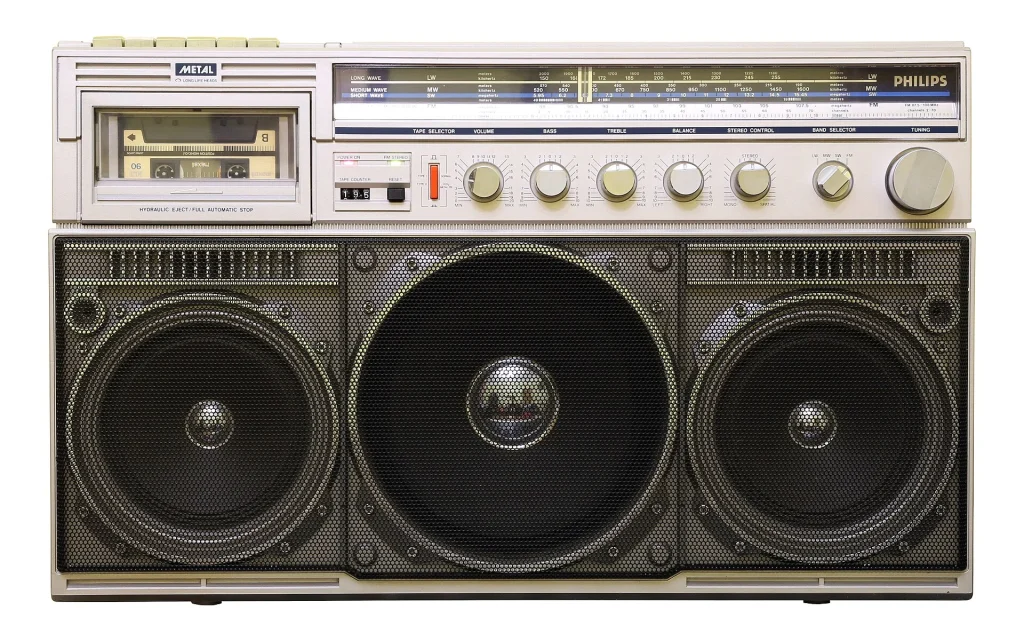
A good boombox is the most fun you can have with a cassette. The best ones from the late 70s and 80s sound far bigger than they look, and they pull in radio, play tapes and record, all in one box. They were also dragged to beaches, garages and job sites for years, so condition varies wildly. Here’s how to find one that still works.
What to Look For
- Tape deck plays, fast-forwards, rewinds and records
- All speakers produce clean sound with no rattles, buzzing or dead channels
- Radio tunes smoothly across the dial and the antenna is intact and straight
- Battery compartment is free of corrosion and the cover is present
- Knobs, sliders and the carry handle are original and unbroken
Popular Models Worth Seeking Out
These names come up again and again for good reason, and parts and service information are easy to find for all of them.
- JVC RC-M70 and RC-M90 — among the most admired boxes ever made, with strong tuners and serious bass. The M90 is expensive; the M70 is the realistic buy.
- Sharp GF series (GF-9000, GF-777) — big, loud and well built. The twin-deck GF-777 is a collector piece, while smaller GF models are affordable.
- Panasonic RX series (RX-5050, RX-5350) — dependable mid-size boxes with good radio sections and simple, repairable tape mechanisms.
- Sanyo M series (M9990, M-X920) — often overlooked, so prices stay reasonable for the sound you get.
Our Pick: A Serviced Mid-Size Single-Deck Boombox
Skip the giant collector grails for a first purchase. A mid-size single-cassette box from JVC, Panasonic or Sanyo with fresh belts gives you most of the sound for a fraction of the price, and it’s much easier to ship without damage.
THE VERDICT
- Belts: Replaced
- Tape Deck: Play and record tested
- Speakers: All drivers working
- Battery Bay: Clean, cover included
Best for: anyone who wants big, room-filling 80s sound and a tape deck in one box they can carry by the handle.
Pros & Cons
Pros
- Radio, tape player and recorder in a single unit
- Runs on mains power or D-cell batteries
- Large speakers give a fuller sound than any portable player
Cons
- Heavy and fragile to ship, so packing quality matters
- Popular models have climbed sharply in price
Common Problems to Watch For
- Perished belts — the deck won’t move, or it plays slowly and unevenly. Most boxes need two to four belts, and kits are available for popular models.
- Scratchy volume and tone controls — dirty potentiometers and sliders crackle when moved. Contact cleaner usually fixes it.
- Blown or rotted speakers — foam surrounds crumble with age and paper cones tear. Listen for buzzing at moderate volume.
- Battery corrosion — leaked D cells can eat the contacts and wiring. Check the bay and the area around it.
- Broken antenna or missing knobs — cosmetic, but original replacements for sought-after models are costly.
How Much Should You Expect to Pay
- $40–$80: Untested or partly working, sold as-is
- $80–$200: Working mid-size boxes from the main Japanese brands
- $200–$500: Serviced, clean examples of the better-known models
- $500+: Collector grails such as the JVC RC-M90 or Sharp GF-777
Caring for Your Boombox
- Remove the batteries when it will sit unused for more than a few weeks
- Clean the tape heads and pinch roller with isopropyl alcohol every 20 to 30 hours of play
- Work every knob and slider now and then to keep the contacts clean
- Carry it by the handle only if the handle mounts feel solid
Quick Questions, Answered
Can I connect my phone to a vintage boombox?
Often, yes. Many have a line-in or aux input on the back, usually on RCA or 3.5mm jacks. For boxes without one, a cassette adapter does the job.
Are the batteries expensive to run?
They can be. Larger boxes take six to ten D cells, so most owners use mains power at home and keep batteries for trips out.
Is a twin-deck model better?
Only if you want to copy tapes. Two decks mean twice the belts and twice the mechanisms to service.
Ask the seller for a short video of a tape playing with the volume turned up. It shows speed stability, both channels and speaker condition in ten seconds.