
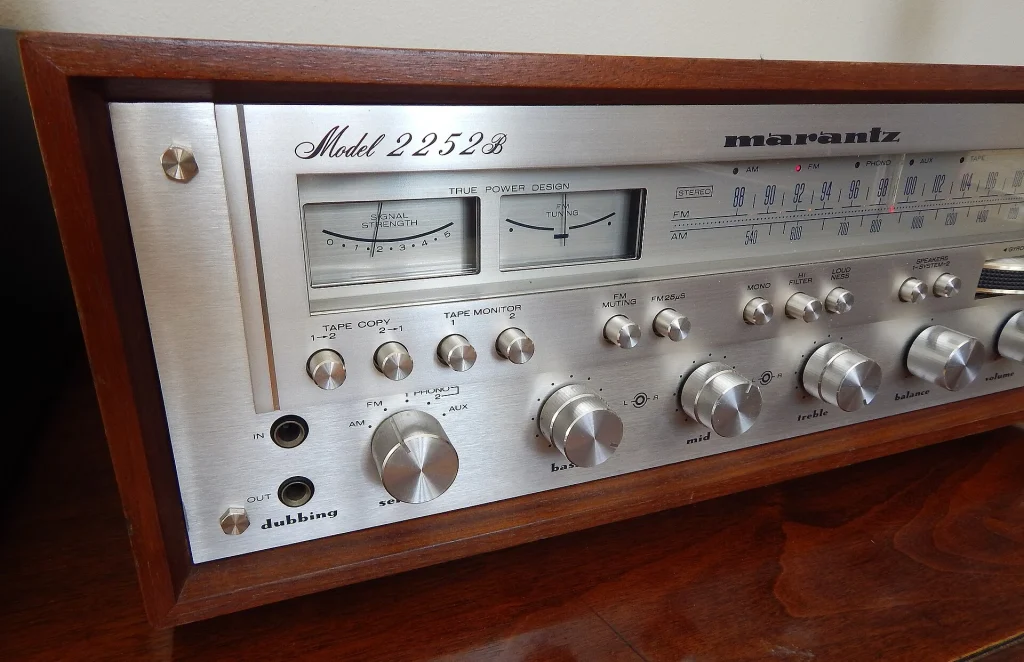
A 1970s stereo receiver is the heart of a classic hi-fi system: amplifier, radio tuner and phono preamp in one heavy, handsome box. The good ones were built to last decades and can be repaired almost indefinitely. But fifty-year-old electronics need attention, and a faulty receiver can damage speakers. Here’s what to check.
What to Look For
- Both channels play at equal volume on every input, including phono
- Volume, balance and tone controls turn without crackling or dropouts
- Dial lamps and meters light up, and the tuner pulls in FM stations in stereo
- No hum, hiss or thump through the speakers at idle or on power-up
- Speaker terminals, faceplate and wood case are intact
Popular Models Worth Seeking Out
The big Japanese makers dominated this era, and all of these lines have strong parts and repair support.
- Marantz 22xx series (2215B, 2230, 2270) — the famous blue-lit dials and a smooth, warm sound. Prices reflect the reputation.
- Pioneer SX series (SX-650, SX-750, SX-850) — well built, widely available and easy to service. A sensible first choice.
- Sansui receivers (5000X, 7070, 9090) — rich sound and solid build, with the larger models now highly collectible.
- Yamaha CR series (CR-620, CR-820) — clean, neutral sound and understated styling, often priced below the others.
Our Pick: A Serviced Mid-Power Receiver from the 1970s
A model in the 30 to 60 watts per channel range is the sweet spot. It has enough power for most speakers in a normal room, costs far less than the monster flagships, and is simple enough that a technician can service it affordably.
THE VERDICT
- Service: Recapped, or cleaned and tested
- Channels: Both working on all inputs
- Controls: Cleaned, no crackle
- Lamps: Working
Best for: anyone building a first vinyl setup who wants warm sound, real knobs and a phono input built in.
Pros & Cons
Pros
- Amplifier, tuner and phono stage in one unit
- Built to be repaired, with service manuals widely available
- Holds its value well if kept in working order
Cons
- Unserviced units often need new capacitors and a control cleaning
- Heavy, so shipping is costly and risky without good packing
Common Problems to Watch For
- Dirty controls and switches — crackling, or a channel that cuts in and out. Contact cleaner often fixes it.
- Aged capacitors — hum, weak bass or distortion. A full recap is the long-term fix.
- Burned-out dial lamps — common and cheap to replace, and LED kits exist for popular models.
- Failing protection relay — a channel that drops out or takes time to click in after power-up.
- DC offset on the speaker outputs — a fault that can damage speakers, which is why a tested unit matters.
How Much Should You Expect to Pay
- $50–$120: Untested or as-is, often with dead lamps or a weak channel
- $120–$300: Working mid-power models from Pioneer, Yamaha, Kenwood and others
- $300–$700: Serviced examples, and mid-range Marantz and Sansui
- $700+: High-power flagships and fully restored collector models
Quick Questions, Answered
How many watts do I need?
Less than you might think. In a typical room, 20 to 50 watts per channel is plenty with reasonably efficient speakers.
Can I plug a turntable straight in?
Yes. Nearly every receiver of this era has a phono input for moving-magnet cartridges.
Is recapping necessary?
Not always right away, but original capacitors are well past their rated life. Budget for it if you plan to keep the receiver.
Never test an unknown receiver with speakers you care about. Use an inexpensive pair first, and listen for hum or a thump at switch-on before trusting it.