
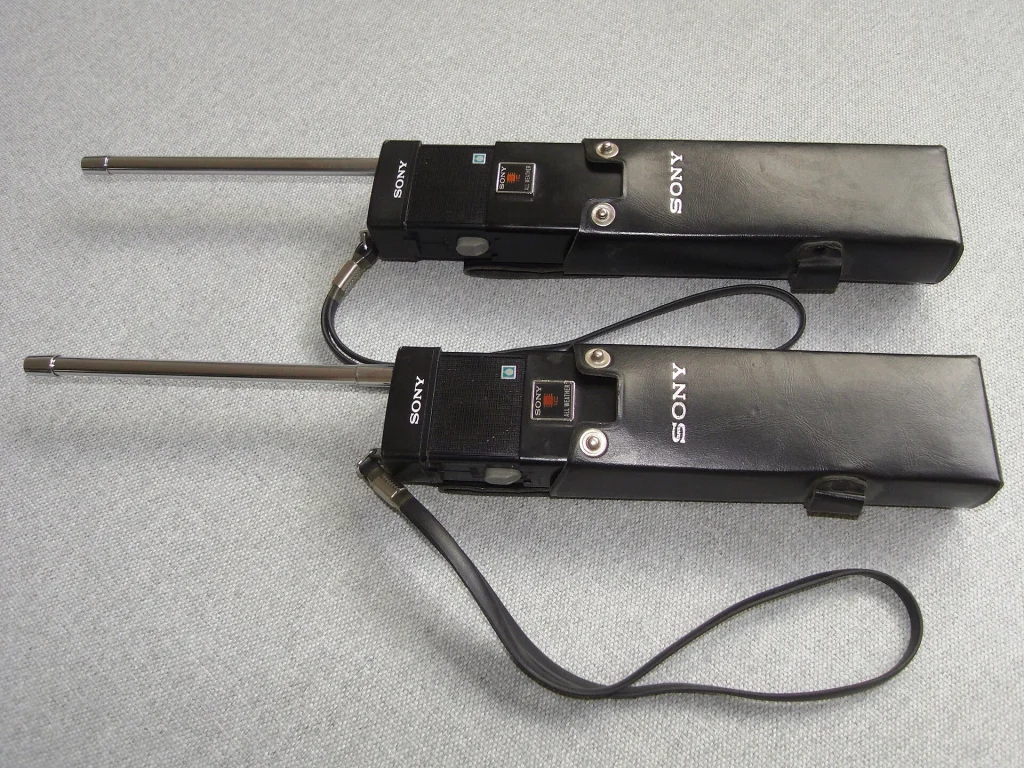
Before cell phones, a pair of walkie-talkies was how you kept in touch across a campsite, a farm or a neighborhood. Vintage handhelds range from toy sets with a single channel to full 40-channel CB radios. In the United States, CB radios need no license, which keeps this an easy corner of the radio hobby to enjoy.
What to Look For
- Both transmit and receive have been tested, ideally against a second radio
- Telescopic antenna is complete, straight and extends fully
- Battery compartment is clean, with no corrosion on the contacts
- You know which channels it covers, since older sets work only on the channels fitted
- Power output suits your needs: toy sets are a fraction of a watt, full handheld CBs several watts
Popular Models Worth Seeking Out
Most vintage handhelds fall into one of these groups.
- Radio Shack Realistic TRC handhelds — very common in the United States, from simple one-channel units to full 40-channel sets.
- Midland and Cobra 40-channel handhelds — capable radios that talk to any CB, including car and base units.
- Sony ICB series — well-made Japanese CB walkie-talkies with handsome styling.
- Lafayette and General Electric handhelds — sturdy 1960s and 70s sets, usually with a few crystal-controlled channels.
- Toy and novelty sets — low-power pairs sold for children, fun to display but short on range.
Our Pick: A Tested 40-Channel Handheld CB
A 40-channel handheld is the most useful vintage walkie-talkie. It works with every other CB radio, it has enough power for real use, and no crystals are needed to change channel.
THE VERDICT
- Transmit: Tested
- Receive: Tested
- Antenna: Complete
- Battery Bay: Clean
Best for: collectors and families who want simple two-way radios with retro style.
Pros & Cons
Pros
- No phone network needed, and no license for CB in the United States
- Talks to any other CB radio on the same channel
- Inexpensive to buy
Cons
- Range is limited to a mile or two at best with a handheld antenna
- Bulky, and most need eight or more AA batteries
Common Problems to Watch For
- Battery corrosion — the most common fault, since these were often put away with batteries inside.
- Bent or broken antenna — reduces range sharply, and exact replacements can be hard to match.
- Missing crystals — older sets need a pair of crystals for each channel, and both radios must share a channel to talk.
- Dirty switches and controls — crackling audio or a push-to-talk button that only works some of the time.
- Weak or dead transmitter — the radio receives but cannot be heard by others.
How Much Should You Expect to Pay
- $10–$30: Toy pairs and single-channel sets
- $30–$70: Working crystal-controlled sets with a few channels
- $40–$100: 40-channel handheld CBs
- $100+: Boxed pairs and collectible Sony models
Quick Questions, Answered
Do I need a license?
Not for CB radio in the United States. Rules differ elsewhere, and professional radios on other bands generally do need one.
How far will they reach?
Expect a few hundred yards from toy sets and a mile or two from a full-power handheld in open country.
Will two different brands talk to each other?
Yes, if both are CB radios set to the same channel. Many low-power sets are fixed on channel 14.
Buy handhelds in pairs when you can. A matched, tested pair removes any doubt about channels and crystals, and you can prove both radios work the moment they arrive.